
connect
Our team is here to help. Contact our office or schedule an appointment below to take your next step!

Maybe you caught yourself in a photo and scrolled past it faster than usual. Maybe veneers came up over dinner with a friend, half-joking, and then the subject changed. You've looked at a few before-and-after photos and still haven't picked up the phone. That's a common place to be, and this article is meant to help you move from curious to informed.
Most healthy adults with cosmetic concerns about their smile are reasonable candidates for veneers. What actually decides it comes down to a handful of clinical details a dentist needs to evaluate in person: the health of your gums, how much natural enamel you have left, how your teeth come together when you bite, and whether you grind your teeth at night.
Dr. Chase and the team at Summit Dental Studio look at all of that before anyone talks about shade or shape, so you leave knowing exactly where you stand.
Call our Dayton office at (937) 977-1818, or request a visit here.
Veneers are thin porcelain shells bonded to the front surface of your teeth. They cover what's visible when you smile, which means they can transform your smile's appearance without touching the back or inner structure of the tooth.
They tend to be a strong fit for concerns like:
There are also things veneers aren't designed to do. They can't replace a missing tooth, which is a conversation about dental implants. They can't correct a bite that's genuinely misaligned, since that's a structural issue that goes deeper than the surface.
And if a tooth has been significantly broken down by decay or damage, it may need a crown or broader restorative work rather than a veneer. Cases like those sometimes call for a more comprehensive approach, like full mouth reconstruction.

Candidacy comes down to a short list of things Dr. Chase evaluates during your visit. Each one either clears the path forward or helps us adjust the plan so the end result still holds up the way it should.
Healthy gums come before cosmetic work, every time. Veneers sit right at or just under the gumline, so the tissue around each tooth affects how well they fit, how natural the edge looks, and how long the result holds up.
Active inflammation, bleeding, recession, or gum disease gets addressed before any veneer goes on. If the gum tissue is still changing, the fit and appearance of the veneers will change right along with it. Treating the gums first means the foundation is stable before we build anything on top of it.
Veneers bond directly to the enamel on the front surface of your teeth. Enamel is the hard outer layer that covers each tooth, and it's what gives the veneer something strong to grip. Teeth with significant decay, large fillings, or heavy wear may not have enough healthy enamel left for a veneer to adhere reliably. In those cases, a crown usually serves the tooth better.
It's also worth knowing that placing a veneer requires removing a very thin layer of enamel from the front of the tooth so the porcelain sits flush. Because enamel doesn't grow back, that change is permanent.
A common question we hear is whether veneers are possible if your teeth aren't perfectly straight. Mild crowding or a slightly rotated tooth is often something veneers can visually correct on their own.
But when the bite is significantly off and your upper and lower teeth are putting uneven pressure on specific teeth, veneers placed on top of that will absorb the same uneven forces. Porcelain is strong, but consistent pressure from the wrong angle shortens the life of any restoration.
Grinding and clenching, which dentists call bruxism, is easy to miss because most of it happens while you're asleep. Flattened edges, temperature sensitivity, jaw soreness in the morning, and a partner who has heard the noise at night are all signs we look for during your exam.
When we find evidence of grinding, we plan around it. That usually means a custom nightguard to absorb the force while you sleep, along with careful attention to how the veneers are shaped so your front teeth aren't taking more pressure than they should.
Veneers are not always the first or only answer. Here are a few options that come up often, depending on what is actually bothering you about your smile.
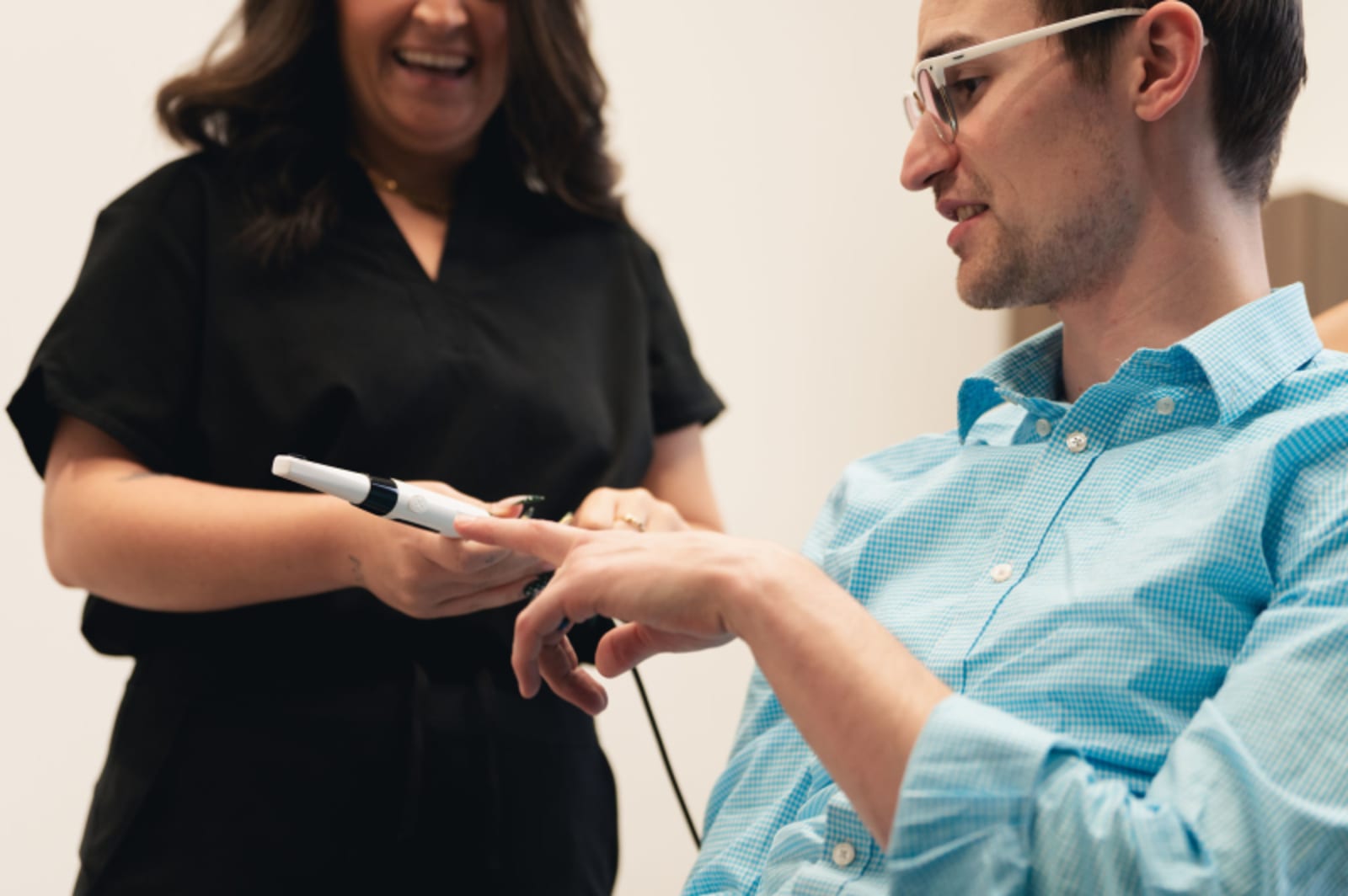
Booking the appointment is the hardest part. Once you're here, the space is comfortable and unhurried, and Dr. Chase's first priority is understanding what's been bothering you before he recommends anything.
Here's what the visit covers:
Before you leave, Dr. Chase walks you through what happens first, what comes later, and roughly how long each stage takes. He handles every stage himself, from evaluation through final placement, so there is no handoff to another provider and the plan stays consistent throughout.

Dr. Chase earned his degree at The Ohio State University College of Dentistry and has spent the years since training in full mouth reconstruction, implantology, and cosmetic dentistry with instructors across North and South America.
In practice, that means he looks at your whole mouth before recommending anything. Your bite, your gum health, your bone structure, and how everything functions together all factor into the plan, because those details determine whether a cosmetic result holds up over time.
What sets this practice apart is that Dr. Chase is the treatment planner, the surgeon, and the restoring dentist. The person who evaluates you at your first appointment is the same person who places your veneers and sees you through to the final result. There is no handoff between providers and no moment where the plan gets lost in translation.
Many of our patients arrive after being told their smile was beyond helping. Getting to show someone what is actually possible after years of carrying that discouragement is the part of this work that never gets old. Dr. Chase is proud to do it right here in his hometown.
This article can help you arrive informed, but the real answer to "am I a candidate?" only comes from an actual exam. Your gums, your enamel, your bite, and your dental history all factor in, and it takes a dentist looking at your specific situation to put the full picture together.
A smile consultation at Summit Dental Studio is exactly that. You bring your questions, Dr. Chase walks you through what he finds, and you leave with a clear, honest path forward, whether that's veneers, another cosmetic option, or something more comprehensive.
Give us a call at (937) 977-1818 and we'll get you scheduled.
Our team is here to help. Contact our office or schedule an appointment below to take your next step!