
connect
Our team is here to help. Contact our office or schedule an appointment below to take your next step!


If you've been wondering whether anything can be done about your smile, the answer is almost always yes. The harder question is which option is right for you, and that depends on what's bothering you, the shape your teeth and gums are in, and how much you want to change. Porcelain veneers are one of the most beautiful answers in cosmetic dentistry. They aren't the only one, and they aren't always the best one.
Dr. Chase and the team at Summit Dental Studio wrote this guide as the thorough version of the conversation we have in our Dayton office every week. It covers the treatments we offer and several we don't, so you can walk into any consultation knowing what you're looking at. If you'd rather talk it through with a person, we're at (937) 977-1818.
Cosmetic dentistry changes how your smile looks, restorative dentistry rebuilds what's broken, and functional dentistry makes your bite work so nothing wears out early. The best treatment plans respect all three at once.
A tooth that's dark because the nerve died needs a restorative answer before a cosmetic one. Front teeth that chip repeatedly usually have a bite problem underneath: pretty new porcelain on a bad bite is porcelain that breaks. Real cosmetic work starts with one question: is this mouth healthy and stable? Once the answer is yes, the artistic part gets predictable.
Porcelain veneers sit right at the seam of cosmetic and restorative. They involve permanent changes to your enamel, which is why they belong in a planned conversation, not an impulse decision.
People rarely open with a procedure name. They open with a feeling: they don't like photos, they cover their mouth when they laugh, they've been hiding a front tooth for years. Underneath that, the concerns cluster into a handful of patterns.
Most people arrive with two or three of these at once, which is why a plan matters more than a product.
Understanding the cause tells you which treatments will actually hold.
Coffee, tea, red wine, tobacco, and dark sauces leave pigment on the outer enamel. Whitening works here because you're lifting color off a surface.
Old trauma can leave a single tooth gray. Certain antibiotics taken in childhood can band the enamel. Whitening barely moves any of this, which is why people end up considering veneers.
Enamel thins over decades, and as it does, the yellower dentin underneath shows through. Teeth that look darker at fifty often haven't stained much at all, they've just gotten more transparent.
Nighttime grinding flattens edges, chips corners, and cracks enamel over years. It's the habit most likely to break a cosmetic result, so we identify it before any work begins.
Citrus, sports drinks, acid reflux, and frequent sipping all soften enamel. The acid source needs managing alongside any cosmetic fix.
Old dentistry ages differently than the tooth around it. A bonded repair from years ago stains at its edges, and mismatched patchwork is a common reason a smile stops looking cohesive.
Teeth move your entire life. If crookedness is the main complaint, straightening first often means far less porcelain later.
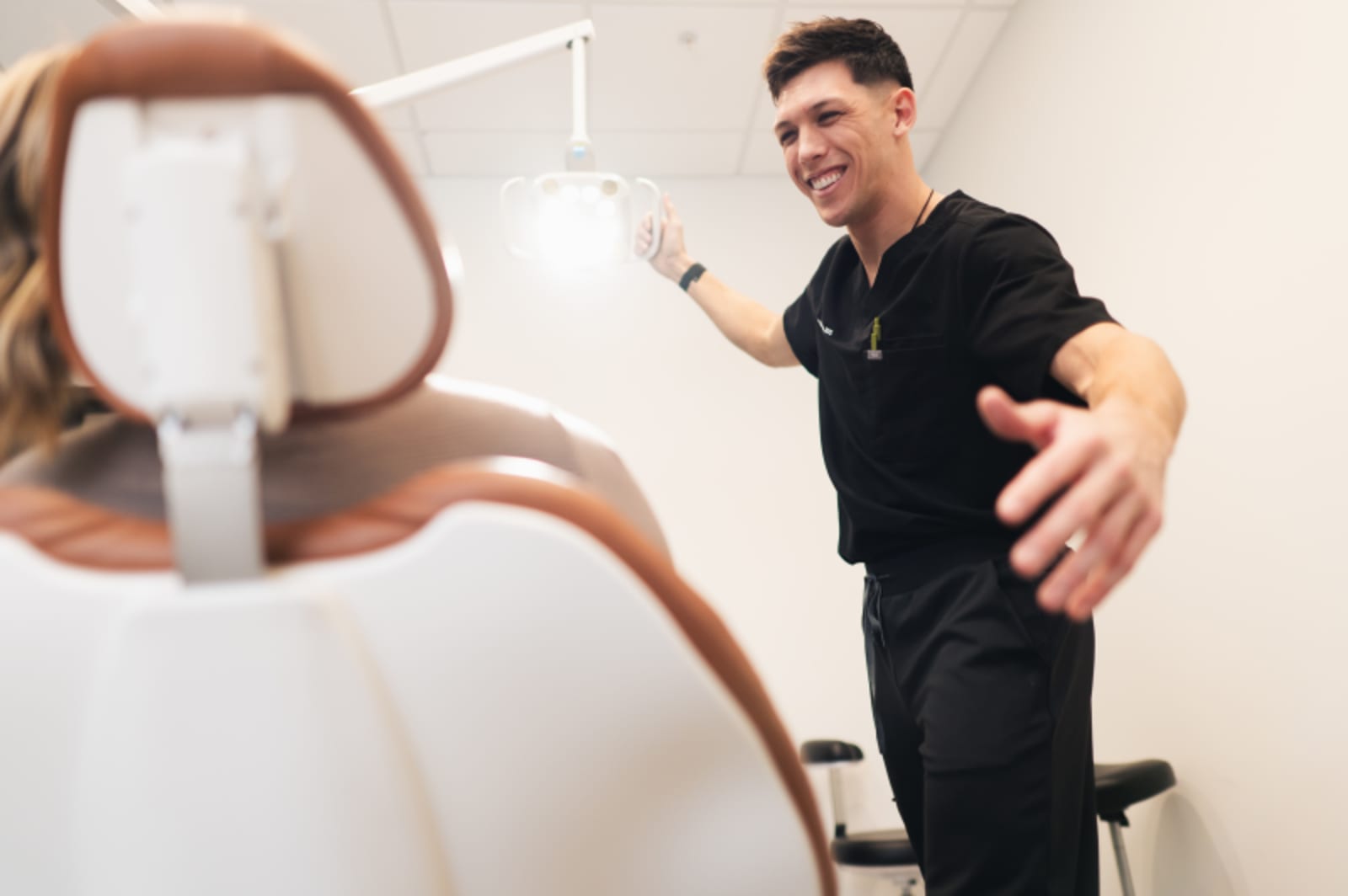
Before anything touches a tooth, we look, measure, and talk. Smile design is its own unhurried appointment.
Digital x-rays, a gum evaluation, existing restorations, and a bite assessment. Decay and gum disease get handled before cosmetic work, always. That's what makes the result last.
We photograph your smile from several angles and review them with you on screen. It's usually the moment people can finally name what's been bothering them.
Modern scanning captures your teeth in three dimensions without goopy trays, letting us study proportion and tooth position relative to your lips and face, and plan the finished shape digitally before anything is prepared.
Color is chosen with you, in good light. Brighter isn't automatically better. The shade should read as your smile.
We may show you a digital preview or a physical mock-up before you commit. Nothing is permanent at this stage.
Cosmetic dentistry is a ladder, and most people don't need to climb as high as they assume.
The simplest change with the least commitment. In-office whitening works quickly; take-home trays work gradually with more control. Nothing is removed from the tooth, and it only addresses color, and only certain kinds of color.
Tooth-colored composite sculpted directly onto a tooth to rebuild a chipped edge, close a small gap, or reshape a slightly odd tooth. Often one visit, less expensive than porcelain, minimally invasive. It stains and chips sooner, so plan on touch-ups.
Gentle reshaping of edges and corners to even out a smile line. Small changes, big visual payoff, no restoration required.
Straightening teeth with a series of clear trays. Aligners move your own teeth, remove nothing from them, and take months rather than weeks.
Reshaping the gum line to correct uneven height or a smile that shows more gum than you'd like. Sometimes the tooth was never the problem; the frame around it was.
Custom shells bonded to the fronts of teeth, changing color, shape, length, and proportion together. The most comprehensive way to redesign front teeth in a short timeline.
Full coverage over a tooth that's structurally compromised by decay, a large old filling, a crack, or root canal treatment. Chosen for strength first, with cosmetics built in.
The replacement for a missing tooth, root and all. A gap changes the balance of a smile, and the surrounding teeth often need attention at the same time. Dr. Chase manages the full process here: treatment planning, surgical placement, and final restoration, all under one roof.
A porcelain veneer is a thin, custom shell of dental porcelain bonded to the front of a tooth, slightly translucent, with depth, so well-made veneers read as teeth instead of as dentistry.
What veneers do beautifully:
Their limits matter just as much. Veneers don't treat decay, gum disease, or infection, and they can't replace a missing tooth or correct a bite that doesn't come together properly.
One more thing to sit with: preparing a tooth for a veneer removes a small layer of enamel, and enamel doesn't grow back. That tooth will need a veneer or crown from then on. Be sure before you start, which is the whole point of the planning phase.
Candidacy comes down to a handful of practical questions.
Cosmetic work sits right against your gums, so inflamed or receding tissue changes what's possible. Healthy tissue is what makes the finished look predictable.
Veneers need enamel to bond to. A tooth already carrying a large filling or significant damage is usually better served by a crown.
If your teeth don't meet evenly, that gets diagnosed and managed first. Otherwise the new work absorbs the same forces that damaged the old teeth.
Not a disqualifier, but it changes the plan. Grinders need a nightguard and a bite that's been thought through, not just porcelain.
Treat the disease first. Cosmetic work placed over it won't last.
In teens and very young adults, teeth and gums are still settling, so conservative options like whitening, contouring, or bonding usually make more sense until things stabilize. The right sequence: aligners before veneers, contouring before restorations, almost always means less treatment overall.
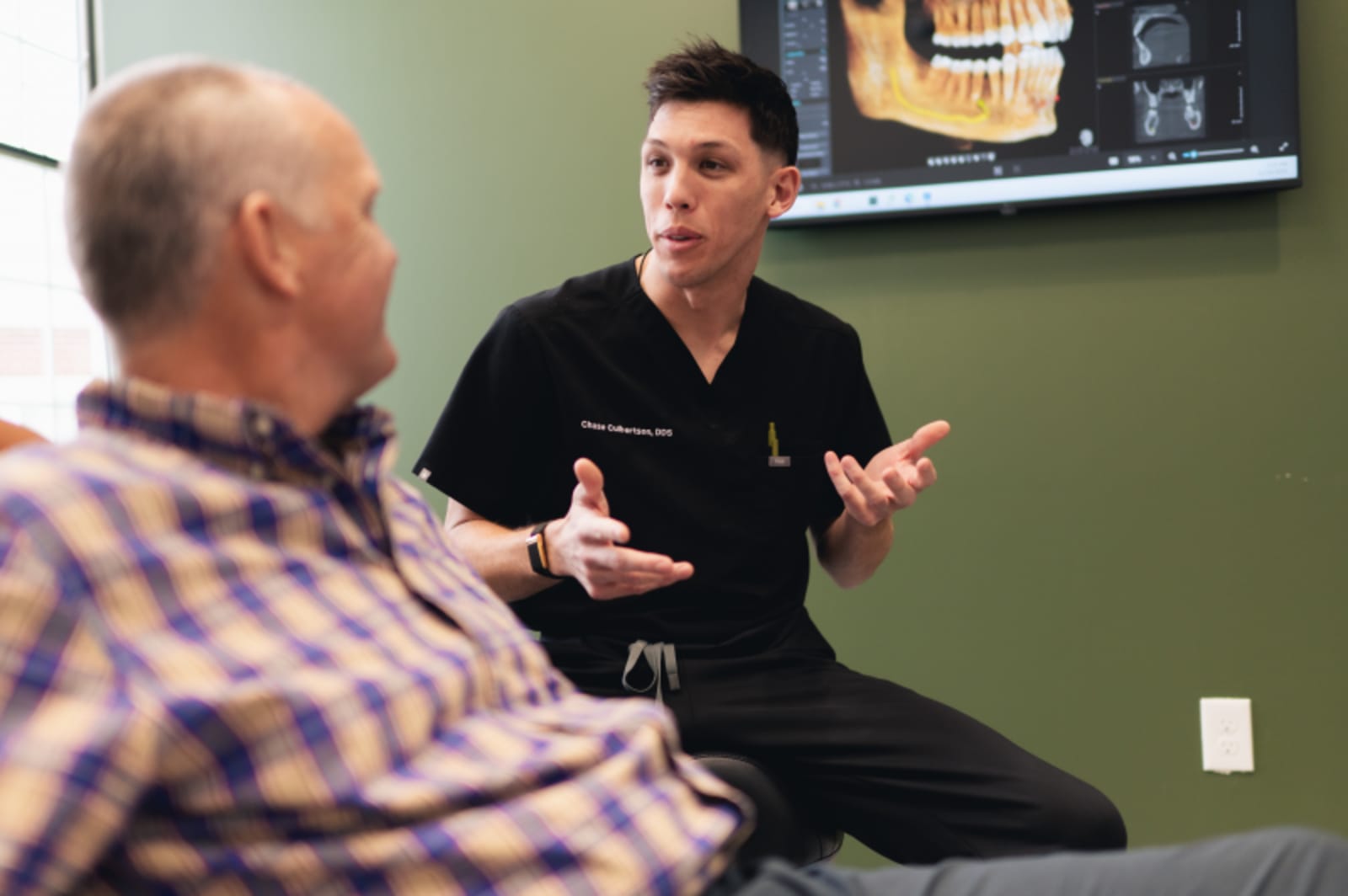
Records, photos, scans, shade discussion, and a real conversation about what you want changed. You leave knowing the plan and the investment before anything begins.
The teeth are numbed and a thin layer of enamel is shaped away to make room for the porcelain. This is the permanent step, and how much is removed is mapped out in advance.
A precise record of the prepared teeth, your bite, and the surrounding tissue goes to the lab so each veneer is built for your mouth specifically.
Temporary veneers protect the prepared teeth and preview the shape and length. Tell us what you like and what you'd adjust.
The finished veneers are placed without permanent cement first. You approve the color and shape in real light before anything is locked in.
The teeth are cleaned and conditioned, the veneers are bonded with adhesive resin, and a curing light sets the bond. Every margin is polished smooth.
We check how your teeth meet in every direction: biting, chewing, sliding side to side. Tiny refinements here decide whether the work feels invisible or intrusive. This part never gets rushed.
There's no real downtime with veneers, but knowing what's normal keeps you from worrying.
Sensitivity. Cold sensitivity for a few days to a couple of weeks is common. It typically fades, and a sensitivity toothpaste helps in the meantime.
Gums. Slight tenderness or pinkness along the gum line usually calms down within a week or two.
Speech and bite. If the shape or length of your front teeth changed, your tongue and lips need a short adjustment. Certain sounds may feel odd for a few days; chewing feels different before it feels normal.
Living with temporaries. Treat them gently: skip sticky or hard foods with the front teeth, and floss by sliding out rather than snapping up.
Call us if sensitivity gets worse instead of better, if something feels high when you bite down, if a gum stays sore beyond a couple of weeks, or if anything catches your floss. All of these are simple to correct early.
Cosmetic dentistry isn't permanent, but it can be durable and maintainable. Realistic expectations, assuming good care:
What determines where you land:
If something chips or comes loose years down the road, individual veneers can usually be replaced rather than the whole set. Bonding is repaired chairside. Crowns get remade.
Cost varies across the ladder. Whitening is the least expensive by a wide margin. Veneers are priced per tooth, so the total depends on how many teeth are part of the plan, the materials and lab work involved, and whether anything else (gum contouring, alignment) needs to happen first.
Insurance rarely helps with purely cosmetic treatment. Plans cover disease and function, so elective veneers and whitening are typically excluded. Where a tooth genuinely needs a crown for structural reasons, coverage may apply to that portion. We'll always tell you which is which.
We won't publish a price here. Real numbers come from a real look at your teeth, and we're glad to talk through payment options when we meet.
One framing that helps some people out is to think in cost per year. Bonding that needs redoing every few years and porcelain that holds for fifteen look very different on a sticker and much closer over a decade.
Plenty of people arrive wanting veneers and discover the smile they're picturing needs a few other things handled first. That's not bad news. It's the reason a sequence exists.
Gum disease, a dying nerve, an uneven bite, a missing tooth: each one gets addressed in the right order before cosmetic work begins. Skipping the sequence is how new porcelain ends up on an unstable foundation.
Full mouth reconstruction coordinates all of it: surgery, implants, restorative work, cosmetics, into one plan with a defined finish line.
Dr. Chase serves as the treatment planner, the surgeon, and the restoring dentist throughout. If you've been mid-treatment somewhere else with no clear end in sight, or you've been told your smile is beyond restoration, Summit Dental Studio is built for exactly that kind of case.

Honest, unhurried, and with a great amount of skill. We start with you: what you'd change, what's felt out of reach, and what a smile that looks genuinely like you would mean for your life. Then we tell you plainly what's possible.
Dr. Chase Culbertson, DDS, earned his Doctor of Dental Surgery degree from The Ohio State University College of Dentistry and went straight after his passion: full mouth reconstruction through surgery, implantology, and cosmetic dentistry, learning from instructors across North and South America.
He plans the treatment, performs the surgery, and completes the restoration, all under one roof. Serving his hometown of Dayton is a privilege he doesn't take lightly. Kubo, his dog and best friend, may well "supervise" your visit.
Here's what a first visit with us actually looks like:
Come as you are; bring a photo ID and your insurance card if you have dental coverage.
We're at 8051 Washington Village Dr, Unit B in Dayton, OH, and you can reach us at (937) 977-1818. Feel free to come in as a patient, and walk out as a friend.
Our team is here to help. Contact our office or schedule an appointment below to take your next step!