
connect
Our team is here to help. Contact our office or schedule an appointment below to take your next step!


You've probably been sitting with this for a while. Maybe it's one tooth that's chipped, a shade darker than the ones beside it, or just a little shorter than it used to be, and every search you run gives you three different answers.
Dr. Chase and the team at Summit Dental Studio hear this question almost every week, so let's untangle it together.
The choice usually comes down to how much healthy tooth structure is still underneath. Bonding adds tooth-colored material directly onto a sound tooth and is typically the quickest option with the lowest upfront cost. Veneers are thin porcelain shells that cover the front surface of a healthy tooth, giving you the most control over shape, color, and proportion. A crown wraps around the entire tooth and is the right call when there is real damage beneath the surface, not just something you want to change about the appearance.
From here, we'll walk you through the four things patients actually weigh when deciding: cost, how long each option lasts, what it permanently asks of your tooth, and whether the decision is even cosmetic in the first place. If you'd rather just talk it through, reach out to our Dayton office or call (937) 977-1818.
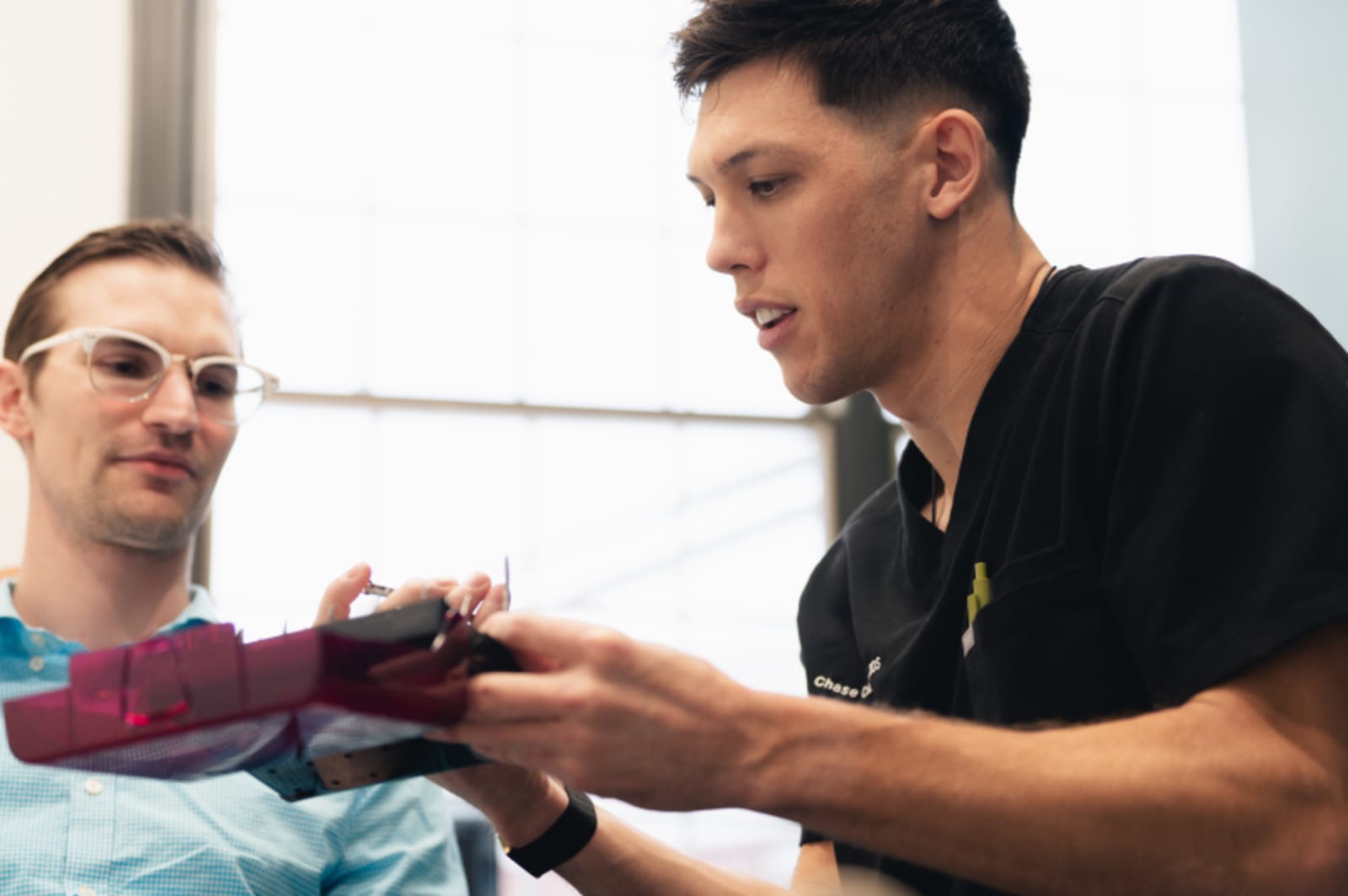
Here's a plain description of what each option involves so the rest of this article makes sense.
A tooth-colored composite resin is shaped directly onto your tooth, hardened with a curing light, and polished until it blends with the surrounding enamel. Your natural tooth stays almost entirely intact, there's usually no lab work involved, and the whole thing is finished the same day. Bonding is the most conservative of the three options, well suited for closing a small gap, rebuilding a chipped corner, or smoothing an edge that catches your lip.
Veneers are thin porcelain shells bonded across the front surface of the tooth. To sit flush and look natural rather than bulky, a small layer of enamel is removed first. That change is permanent since enamel doesn't grow back, so once a veneer is placed, that tooth will always need some kind of covering going forward. What you get in return is strong control over your results: porcelain resists staining, holds its polish over time, and lets us design the shape, length, and color across several teeth so your smile reads as one cohesive result rather than a single repaired tooth.
A crown fits over the entire tooth, covering the top and all sides. Placing one requires reducing the tooth in size so the crown sits over it without feeling oversized in your bite. That's the most involved preparation of the three, and also the most protective. A tooth that's cracked, badly worn, or has been filled multiple times doesn't just need to look better, it needs to be structurally held together, and a crown does that in a way bonding and veneers can't. Our same day crowns keep that repair to a single visit whenever possible.
In short: bonding adds material to a healthy tooth, veneers resurface the front of a healthy tooth, and crowns cover and protect a tooth that needs more than cosmetic help.
Starting with price doesn't make you a difficult patient. It makes you someone trying to make a good decision with real information, and that's a conversation we're glad to have.
The three options sit at three different price points. Bonding is the lowest upfront cost. Veneers land in the middle. Crowns are typically the highest, partly because they require custom lab fabrication and more chair time. When you come in, we go over specific numbers for your specific situation along with payment options, because a ballpark that hasn't accounted for your actual teeth isn't worth much.
Here's where sticker price gets misleading. Bonding is the most likely to need touching up or replacing over time, and the composite resin it's made from picks up staining from coffee, tea, and food in a way that porcelain doesn't. Veneers and crowns hold their color and shape much longer. When you spread the cost across the years you'll realistically have it, the ranking can flip, and the option that costs less today may cost more by year ten if it needs to be redone.
None of that makes bonding the wrong answer. For a single small chip on a tooth you're otherwise happy with, it's often the most sensible choice. It just means the better question isn't "what costs the least right now" but "what costs the least over the full life of this tooth."
Bonding generally holds up in the range of five to ten years before it needs refreshing. Veneers commonly run ten to twenty years with good care. Crowns are the most durable of the three, often lasting fifteen to twenty-five years or more. Those are realistic ranges, not guarantees, and the spread within each range comes down to one thing: habits.
The same restoration that holds up beautifully for fifteen years in one person's mouth may need replacing at eight in another's, simply because of how those two people use their teeth. These are the habits we see shorten a restoration's timeline most often:
None of that is meant as a scolding. It's simply how we figure out which material makes the most sense for you. If you grind at night, we'd talk about porcelain options or a nightguard before settling on composite. If you're generally gentle on your teeth and consistent about checkups, a more conservative option can serve you well for a long time. The goal is always to match the restoration to your actual life, not an idealized version of it.
These three options sit on a spectrum of commitment, and some of what they ask of your tooth is permanent. Bonding is the most flexible: it can be adjusted or removed without changing the tooth underneath, which makes it a good starting point if you're not completely sure what you want yet.
Veneers require removing a thin layer of enamel from the front of the tooth, and since enamel doesn't grow back, that tooth will always need some kind of covering going forward. Crowns require the most preparation, reshaping the entire tooth so the crown has room to fit properly.
None of that is meant to steer you away from any option. Crowns exist because some teeth genuinely need that level of protection, and veneers can create consistency across your smile that bonding can't replicate at the same scale. You just deserve to know exactly what you're agreeing to before treatment begins, and that's a conversation Dr. Chase is glad to have clearly and without pressure.
Sometimes the conversation shifts once you're in the chair. You come in thinking a veneer is the answer, and the exam reveals something the mirror at home couldn't show you. A crack that runs deeper than it looked, decay that spread further inward than expected, or a tooth that's been filled so many times it no longer has enough healthy structure to anchor a veneer reliably.
Veneers and bonding are cosmetic conversations, meaning they're about color, shape, and proportion. Crowns can be cosmetic too, and a well-made crown looks completely natural.
But a crown also serves a structural purpose when a tooth has been weakened from the inside, and that distinction isn't something you can see or feel on your own. It takes a full exam, x-rays, and someone trained to read what's happening beneath the surface.

A little clarity before you arrive changes the whole appointment. A few things worth thinking through beforehand:
You don't need to have everything figured out. If you grind your teeth, please mention it, because it shapes the recommendation more than almost anything else. Bring your questions and we'll walk through everything together.
Dr. Chase built Summit Dental Studio to be the kind of place where this conversation never feels rushed. You'll be seen on time, every option gets a clear explanation including the ones that cost less, and you'll have an intraoral camera right in front of you so you can see exactly what we're looking at together. Some patients come to us having already been told their smile is beyond helping.
Often it isn't. When implants are part of the answer, Dr. Chase manages the entire case from the first treatment plan through surgery and the final restoration, so you're never handed off to someone new mid-treatment.
Bring your questions and your wish list. We genuinely want to hear all of it. Call us at (937) 977-1818 or request a visit. Kubo may be supervising.
Our team is here to help. Contact our office or schedule an appointment below to take your next step!
